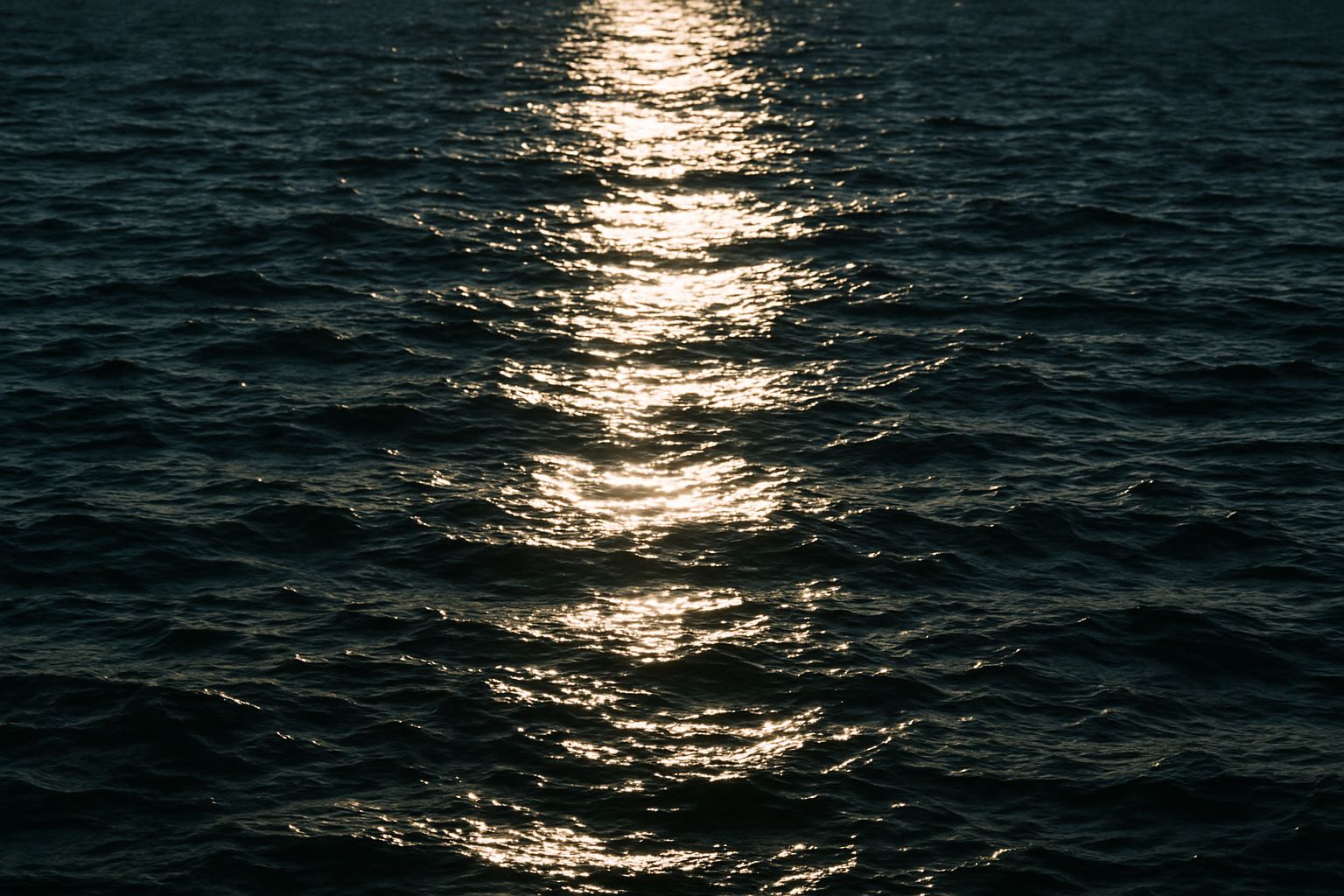
Light arrives from two directions out there
On land, and in the mental model behind almost all sun advice, ultraviolet comes down. You protect the upward facing surfaces: the top of the head, the shoulders, the nose, the tops of the ears. Everything that faces downward or sideways sits in shadow and is treated as protected, because in that model it is.
On water that model breaks. A water surface reflects, so a portion of the ultraviolet arriving from the sky bounces back up. You then receive light from above and from below at the same time, and the parts of you that never see the sun on land are receiving it continuously.
This is the single most important environmental fact in this manual, and it is the reason a surfer's burn pattern looks different from a walker's. The underside of the chin. The strip under the nose. The lower lip. The skin below the eyes and inside the eye socket. Ask anyone who has surfed for years where they burn and the list will not match the list a hillwalker gives you.
A moving surface is not a mirror
A flat calm surface behaves a little like a mirror, and the angle at which light bounces off it is predictable. That is not the surface you surf on.
A real sea is broken into countless small facets, each tilted differently and each moving. Chop, swell, the face of a wave, foam and turbulence all mean the surface is presenting an enormous range of angles at any moment. Light striking that surface does not reflect in one direction. It scatters.
The practical consequence is that you are not standing next to one bright patch. You are sitting inside a field of light that is coming at you from many angles at once, and changing as the surface changes. That is why the glare on the water is so uncomfortable and so hard to shield against, a subject taken up in glare and eye protection.
Foam and white water
Broken white water is a different surface again. Foam is a mass of air and water interfaces, and it is bright. Anyone who has spent a session in the inside, in a whitewater dominated break or teaching in the shorebreak, has been sitting in that brightness for hours.
You do not need a number to act on this, and this manual will not invent one. The directional statement is sufficient: broken white water is brighter than open water, and a session spent mostly in it is a session with more light arriving from below than one spent sitting outside on a glassy morning.
This matters most for the people who spend the most time there, which is beginners and the people teaching them. A surf coach standing chest deep in the whitewater for a three hour lesson, facing the beach, is in one of the more demanding positions on the whole coast, and it is covered in coaching groups.
| Surface | Where it puts you | What it means in practice |
|---|---|---|
| Open water, glassy | Sitting outside on a calm morning | A more mirror like reflection, strongly directional |
| Open water, chopped up | Most sessions | Scattered reflection arriving from many angles at once |
| Broken white water | The inside, teaching, beginners | The brightest water surface you will spend time on |
| Wet sand at low tide | The walk out and back | A wide bright horizontal expanse with no shade on it |
| Pale dry sand | Changing, waxing, waiting | Reflective ground during the part of the day nobody counts |
| Light rock, concrete, sea wall | Slipways, car parks, the sit afterwards | Bright ground, usually at the strongest time of day |
Working framework of this manual. It is not a measurement, it is not drawn from any study, and it carries no numbers we cannot source.
Wet sand, dry sand and the walk back
The water is not the only reflective surface in play. Wet sand at low tide is a broad, bright, near horizontal expanse. Pale dry sand reflects too. Light coloured rock, concrete slipways and painted sea walls all contribute.
Which means the exposure does not stop at the water's edge. The walk out across a wide low tide beach, the twenty minutes putting a wetsuit on, the sit on the wall afterwards eating something, the wax and the chat: all of it takes place on bright ground with no shade, usually in the middle of the day, and usually with nobody thinking about it because the session has not started or has finished.
The beach time either side of a session is genuinely underrated as an exposure. It is the part of the day when people have already decided they are not exposed.
What this changes about your cover decisions
Three practical consequences follow, and they are the reason this article exists.
Cover the underside as well as the top. When you apply anything to your face, the instinct is to do the forehead, the nose and the cheekbones. Add the underside of the chin and the jawline, the strip between the nose and the upper lip, and under the nostrils. Those areas are receiving reflected light for the whole session and almost nobody covers them.
Do not rely on a brim. A peak or a brim shades from above. It does nothing about light coming from below, which is why a cap that would be adequate on a hill is only a partial answer on the water. Headwear still matters enormously, for the scalp and the top of the head, and it is dealt with in hoods, caps and headwear. It simply does not solve the reflected component.
Take the eyes seriously. Reflected light off water is exactly the geometry that gets under a brim and into the eye. This is one of the few places where the argument for eye protection is specific to the environment rather than general.
Why there is no number here
You will find figures quoted for how much ultraviolet water reflects. They vary enormously depending on sun angle, on surface state, on what is dissolved and suspended in the water, on whether the surface is broken and on how the measurement was taken. A single reflectance figure applied to a real sea is close to meaningless, and repeating one here would be exactly the kind of borrowed statistic this manual refuses to publish.
What is not in doubt, and what public health bodies including the World Health Organization state plainly in their UV index guidance, is the direction: reflective surfaces including water increase the ultraviolet exposure of people near them. Direction is enough. Direction tells you to cover the underside of your chin, and no number would tell you anything more useful than that.
One thing that does reduce it
Ultraviolet is attenuated with depth in water. Being under the surface is a genuine reduction, and duck diving, wipeouts and time spent under are periods of lower exposure.
This is of almost no practical use, because the proportion of a session spent underwater is small. The overwhelming majority of a surf session is spent sitting on the surface with your head and shoulders in the air, or paddling with your head up, or standing on a board. Being in the water is not the same as being under it, and the exposure model that matters is the one for a head above a reflective surface for three hours.
What to take away
On the water you receive ultraviolet from above and from below, and the below component reaches the places that sit in shadow on land: under the chin, under the nose, the lips and around the eyes. A broken moving surface scatters that light at many angles rather than reflecting it in one.
Cover the undersides, do not expect a brim to solve it, take eye protection seriously, and remember that the bright ground on the beach either side of the session counts too.